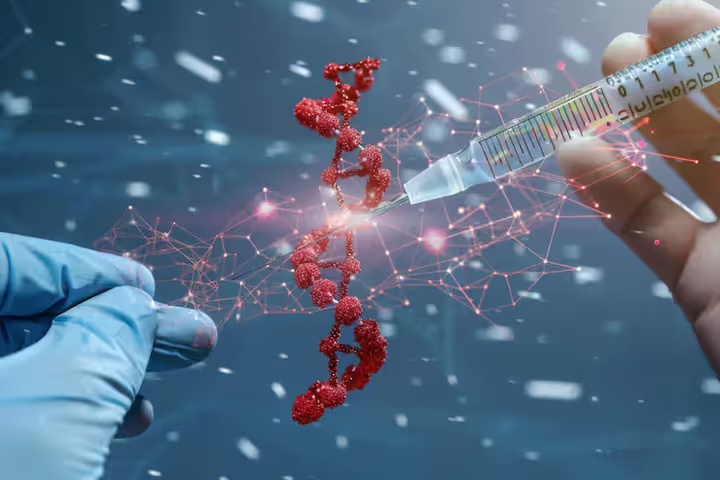
Guide to RNA Sequencing : Why It’s Essential for Genetic Research
RNA sequencing, commonly known as RNA-seq, is a widely used method for studying gene expression and understanding how cells function at the molecular level. It exists because living organisms constantly use RNA to translate genetic information into proteins, which shape nearly every biological process. Traditional genetic analysis focused mostly on DNA, but scientists eventually recognized the need to study RNA to capture real-time activity within cells. This shift led to the development of high-resolution sequencing techniques that reveal how genes respond to internal and external conditions.
RNA-seq helps researchers examine thousands of RNA molecules simultaneously, allowing them to observe patterns, changes, and variations that were once impossible to measure. By providing insights into gene activity, cell behavior, and biological pathways, RNA sequencing has become essential in fields such as molecular biology, genetic research, environmental biology, agriculture, and developmental studies. It supports a deeper understanding of the link between genetic information and how organisms adapt, grow, and function.
Importance: Why RNA Sequencing Matters Today
RNA-seq is valuable because it captures dynamic biological information that DNA alone cannot provide. As research shifts toward understanding how genes behave rather than simply identifying their structure, RNA sequencing has become a foundational technique in modern science.
Several areas benefit from RNA sequencing insights:
-
Genetic research
It helps identify patterns of gene regulation, alternative splicing, and biological responses under different conditions. -
Developmental biology
Researchers can track how cells change as organisms grow and differentiate. -
Environmental and ecological studies
RNA-seq allows scientists to examine how organisms react to stressors such as temperature, pollution, or nutrient changes. -
Agricultural and plant sciences
It supports studies on crop resilience, plant growth patterns, and genetic traits related to yield and adaptation. -
Biological data interpretation and computational analysis
RNA-seq produces large datasets, encouraging advances in data science, bioinformatics, and machine learning models used to interpret genomic information.
The method is essential because it solves problems related to limited visibility into gene function. Instead of predicting gene activity, researchers can now directly measure gene expression. This leads to more accurate interpretations of how biological systems respond to environments, treatments, or natural processes.
Recent Updates: Trends and Advancements from the Past Year
RNA sequencing continues to evolve as technology improves. Several updates and trends have been notable over the past year:
Advances in single-cell RNA sequencing (2024–2025)
Single-cell RNA-seq (scRNA-seq) allows researchers to study individual cells rather than entire tissue samples. Recent improvements have increased resolution, reduced noise, and enhanced data interpretation methods. Studies published throughout 2024 reported improved accuracy in identifying rare cell populations.
Growth of long-read sequencing technologies
Platforms using long-read technology gained traction in 2024. These methods allow scientists to observe full-length RNA transcripts, improving the understanding of complex gene structures and alternative splicing.
Machine learning tools for expression analysis
From early 2024 to mid-2025, new computational frameworks were introduced. These tools help interpret large datasets generated from RNA-seq, making analysis more accessible and more precise for researchers.
Spatial transcriptomics becoming mainstream
By 2025, more labs adopted spatial transcriptomics methods, which combine RNA sequencing with tissue-level mapping. This enables researchers to see where gene activity occurs within biological structures, providing a detailed view of cellular environments.
These updates reflect a broader shift toward high-precision sequencing, deeper gene expression mapping, and improved computational interpretation within genetic research.
Laws or Policies: How Regulations Influence RNA Sequencing Work
Regulations related to RNA sequencing differ across countries, but several broad policies influence how research is conducted.
Data privacy and genomic information
Many regions implement rules to protect sensitive biological data. Policies such as:
-
Genetic data protection requirements
-
Ethical review frameworks
-
Consent guidelines for biological sample collection
These rules ensure that genomic information is handled responsibly and transparently.
Laboratory standards and quality practices
Countries often enforce biosafety and laboratory operation standards that apply to sequencing facilities. These include:
-
Guidelines for handling biological samples
-
Protocols for safe storage and disposal
-
Requirements for lab accreditation
Such measures help maintain accuracy and quality in RNA sequencing studies.
Research funding and national genomic programs
Governments may support genetic research through national initiatives that set expectations for data management and scientific transparency. These programs influence how researchers design sequencing studies and share findings in broader research networks.
While specific rules vary, the overall regulatory environment encourages ethical, high-quality genetic research and responsible biological data interpretation.
Tools and Resources: Helpful Platforms for RNA Sequencing Research
Many tools simplify the process of data analysis, visualization, and interpretation in RNA sequencing projects. Below are commonly used and beginner-friendly resources:
Bioinformatics platforms
-
Galaxy Project – A web-based platform for running RNA-seq pipelines without coding experience.
-
NCBI Gene Expression Omnibus (GEO) – A repository of public gene expression datasets for research and comparison.
-
ENA (European Nucleotide Archive) – Another major source of genomic datasets used for reference studies.
-
UCSC Genome Browser – Helps visualize gene locations, transcripts, and annotation tracks.
Data analysis tools
-
DESeq2 – Used for differential gene expression analysis.
-
EdgeR – Popular for analyzing count data from sequencing.
-
Seurat – Widely used for single-cell RNA-seq processing and visualization.
Workflow and pipeline builders
-
Nextflow
-
Snakemake
These help researchers create consistent pipelines for large-scale sequencing projects.
Visualization and interpretation tools
-
Heatmapper – For generating gene expression heatmaps.
-
ComplexHeatmap (R package) – Advanced visualization for large datasets.
FAQs
What is RNA sequencing used for?
RNA sequencing is used to measure gene expression, identify transcripts, study alternative splicing, and understand how genes behave in different conditions. It gives researchers insight into active biological processes.
How is RNA-seq different from DNA sequencing?
DNA sequencing reveals the structure of genes, while RNA sequencing shows how those genes are used. RNA-seq focuses on gene activity rather than genetic code alone.
Can RNA sequencing study individual cells?
Yes. Single-cell RNA sequencing is a growing method that allows researchers to examine gene expression at the level of individual cells, improving understanding of cellular diversity.
What type of data does RNA-seq produce?
It generates large datasets containing counts of RNA molecules, expression profiles, transcript structures, and sometimes spatial information if advanced methods are used.
Is RNA sequencing used outside of medical research?
Yes. It is applied in agriculture, ecology, evolutionary studies, environmental monitoring, and general molecular biology.
Conclusion
RNA sequencing has become an essential technique for understanding gene expression and exploring complex biological systems. Its ability to reveal real-time genetic activity provides researchers with insights that were previously difficult to obtain. With advancements in single-cell analysis, machine learning tools, spatial transcriptomics, and long-read methods, RNA-seq continues to evolve and expand its role in genetic research.
As scientific fields increasingly depend on accurate gene expression data, RNA sequencing will remain a critical component of biological investigation. Its continued development supports deeper knowledge, better interpretation of molecular processes, and a more comprehensive understanding of life at the genetic level.
Disclaimer: The information provided in this article is for informational purposes only. We do not make any claims or guarantees regarding the accuracy, reliability, or completeness of the information presented. The content is not intended as professional advice and should not be relied upon as such. Readers are encouraged to conduct their own research and consult with appropriate professionals before making any decisions based on the information provided in this article.